Heat Pump Guide
Daikin vs Mitsubishi Heat Pump: 2026 Quote Guide
Daikin vs Mitsubishi heat pump comparison: system type, cold-weather output, installed cost, controls, warranty, service path, and quote risks.
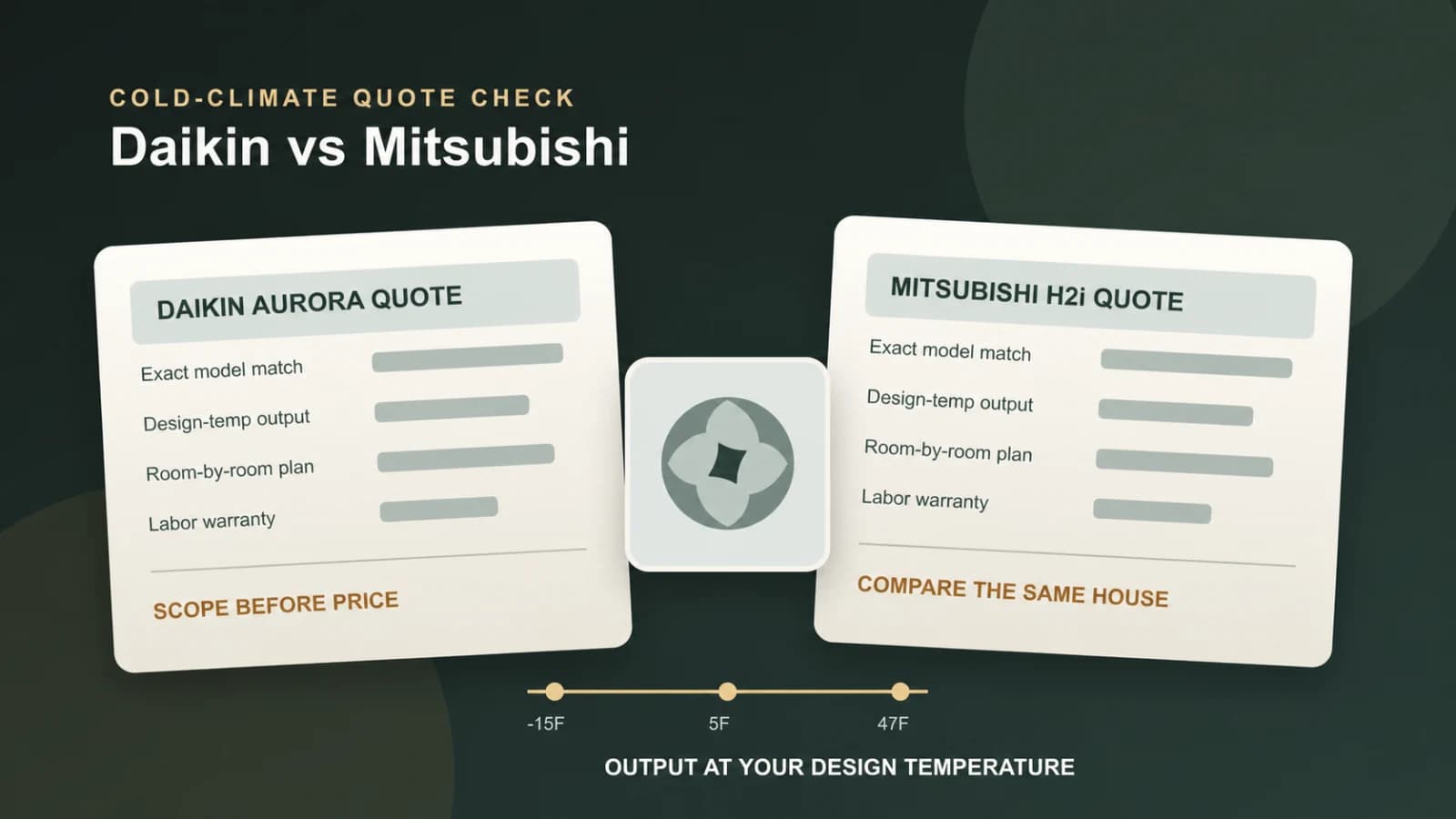
Quick answer: Choose Daikin when a current AURORA or FIT AURORA system matches the house and the stronger local contractor offers the better written scope. Choose Mitsubishi when an exact Hyper-Heating H2i system gives the better room-by-room design, low-temperature proof, and local service path. Compare the same distribution type first, then exact model output, controls, registration, and labor coverage.
Best for
US homeowners holding Daikin and Mitsubishi heat pump quotes, especially in cold climates or older homes.
Wrong fit
A substitute for Manual J, an AHRI match, duct testing, electrical load review, or a licensed contractor's room-by-room design.
Tradeoff
Daikin offers both compact ducted FIT AURORA and AURORA ductless lanes; Mitsubishi offers broad H2i ductless, ducted, and multi-zone choices. The better badge is irrelevant if the proposals solve different distribution problems.
Daikin and Mitsubishi both make credible cold-climate heat pumps. The better quote is the one that solves the same rooms, covers the calculated load at your local winter design temperature, and comes with a service and labor commitment you can enforce.
Do not compare a Daikin FIT AURORA central ducted bid with a Mitsubishi wall-mounted multi-zone bid by price alone. They are different distribution projects. Normalize system type first, then compare exact outdoor and indoor model numbers, low-temperature output, controls, warranty conditions, and everything included in the install.
Quick answer
Choose Daikin when the exact AURORA or FIT AURORA system fits the house, the contractor can document cold-weather output and distribution, and the written scope is stronger for the price. Daikin FIT AURORA DH9VS is especially relevant when usable ducts and a compact side-discharge cabinet make a central system the cleanest solution.
Choose Mitsubishi when an exact Hyper-Heating H2i system provides the better room-by-room ductless, low-static ducted, or mixed design and a qualified local contractor can support it after installation. Mitsubishi is not automatically the cold-weather winner: H2i and H2i plus claims vary by exact system generation and match.
Our verdict is distribution first, exact model second, installer third, price fourth. A $3,000 brand premium is not justified until the proposal shows what extra capacity, room coverage, controls, commissioning, labor warranty, or service access it buys.
Already holding both proposals? Send the complete Daikin and Mitsubishi quotes for a written comparison. No phone call is required.
Method and evidence limits
This comparison was refreshed September 1, 2026 using current US manufacturer product pages, specification sheets, warranty pages, one disclosed Massachusetts Mitsubishi price source, and one third-party Daikin replacement-cost compilation. Manufacturer claims are treated as model-specific, not brand-wide reliability proof.
We found no public US dataset that compares Daikin and Mitsubishi failure rates by current residential model, installation quality, climate, and service history. We therefore do not assign a reliability score or claim that one brand lasts longer. Recent homeowner discussions are used only to identify questions buyers repeatedly ask about exact models, refrigerants, thermostats, dealer status, and quote scope.
Daikin vs Mitsubishi at a glance
| Decision field | Daikin | Mitsubishi | What belongs in the quote |
|---|---|---|---|
| Ductless cold-climate lane | AURORA single- and multi-zone systems, including current R-32 MXT | Hyper-Heating H2i single- and multi-zone systems, including current R-454B families | Exact outdoor and every indoor model, combination table, room schedule |
| Central ducted lane | FIT AURORA DH9VS, current R-32, 2 to 5 tons | Ducted H2i and compatible air-handler or low-static combinations | Static pressure, airflow by room, duct leakage, matched capacity |
| Published cold-weather headline | AURORA MXT publishes up to 114% rated heating capacity at 5F and operation to -13F | H2i plus pages publish 100% heating capacity to -5F and guaranteed heating to -13F; some new systems operate lower | Extended performance data for the exact match at local design temperature |
| Current refrigerant transition | Current AURORA and FIT families include R-32 | Current FX, GX, SMART MULTI, and other families include R-454B; older R-410A stock remains | Refrigerant and generation written for every indoor and outdoor component |
| Controls | Daikin One ecosystem or model-specific wireless/app controls | Mitsubishi Comfort app, wireless/wired controls, and model-specific interfaces | Exact thermostat, adapter, app, remote access, and commissioning responsibility |
| Best advertised warranty path | Certain registered products advertise 12-year parts or unit-replacement coverage with conditions | Eligible single-family systems can receive 12-year parts/compressor coverage | Registration owner, deadline, contractor tier, maintenance, labor, exclusions |
| Main quote risk | “Daikin AURORA” or “Daikin FIT” with no exact tier, match, or distribution proof | “Mitsubishi Hyper-Heat” with no exact H2i match, room loads, or combination data | Full model schedule and one accountable service company |
The two cold-weather headlines above are not a head-to-head test. They refer to different product families, temperatures, and rating bases. Use them to request the exact tables, not to declare a winner.
First gate: compare the same system type
| House condition | Daikin lane to compare | Mitsubishi lane to compare | Do not accept |
|---|---|---|---|
| Usable central ducts | FIT AURORA DH9VS with matched air handler or furnace | Ducted H2i with exact outdoor and air-handler match | A central bid with no measured airflow, static pressure, or room delivery |
| No useful ducts | AURORA single-zone or MXT multi-zone | H2i or H2i plus single-zone, MXZ, or SMART MULTI | A price comparison with different room counts or indoor-unit types |
| Mixed old house | AURORA wall, floor, or concealed units plus retained heat where designed | Wall, ceiling, low-static, or mixed H2i layout plus retained heat where designed | “Whole home” with rooms still depending on open doors or undocumented backup |
| Tight outdoor clearance | Side-discharge FIT AURORA or compact ductless outdoor unit | Side-discharge Mitsubishi outdoor unit for the exact system | A placement promise without snow, service, sound, drain, and property-line clearances |
If the two contractors proposed different distribution types, use the ducted vs mini-split guide before comparing brands. The cheaper proposal may simply serve fewer rooms or reuse ducts the other contractor judged inadequate.
Cold-weather proof: compare capacity, not the lowest operating number
Daikin's current AURORA MXT page publishes up to 114% rated heating capacity at 5F and operation to -13F for the multi-zone family. Mitsubishi's current wall-mounted page says H2i plus models can provide 100% heating capacity at -5F with guaranteed heating to -13F. Mitsubishi also states that some newer R-454B all-climate systems can operate as low as -22F.
Those numbers cannot be ranked without the exact model, indoor combination, and load. “Operates at -22F” does not mean “covers this house at -22F.” “114% at 5F” does not prove the same output at a colder design temperature.
Daikin's October 2025 DH9VS specification shows why tonnage-level proof matters even within one family:
| FIT AURORA DH9VS nominal size | Maximum heat at 47F | Maximum heat at 5F | 5F output relative to the 47F figure |
|---|---|---|---|
| 2 ton | 24,000 BTU/h | 24,000 BTU/h | 100% |
| 3 ton | 34,200 BTU/h | 34,200 BTU/h | 100% |
| 4 ton | 48,000 BTU/h | 44,000 BTU/h | 92% |
| 5 ton | 54,000 BTU/h | 47,000 BTU/h | 87% |
These are published maximum outdoor-unit figures, not proof that every indoor match delivers the same number in your house. Ask each bidder to place the Manual J load and exact system output at your design temperature on the same page, then show any backup shortfall.
The current-generation trap: R-32 vs R-454B
Current Daikin US product pages show R-32 across AURORA ductless and FIT AURORA systems. Mitsubishi launched R-454B FX, GX, SMART MULTI, and other US residential families beginning in 2025, while some R-410A equipment and warranty documents remain current for specific models.
Refrigerant alone should not decide the quote. It should trigger five written checks:
- What is the complete outdoor model number?
- What refrigerant does that exact outdoor unit use?
- Are every indoor unit, coil, air handler, branch box, and control approved for that match?
- Does the contractor stock or have distributor access to parts for this generation?
- Which warranty statement applies to the installation date and model family?
Reject a proposal that mixes a new-family outdoor headline with a legacy indoor model or warranty page without proving the combination is approved.
Heat Pump Guide
Want a second read on the quote?
Paste the proposal or upload the PDF. No lead auction.
Free. No sales pitch. Personal reply in ~2 business days.
Still researching? Send me the guide
Which is better for an older house?
An older house adds distribution and infrastructure risks that brand comparisons often skip.
Choose the ducted lane only after the ducts pass. A Daikin FIT AURORA or Mitsubishi ducted system still needs measured external static pressure, available airflow, return capacity, leakage, and room delivery. A compact outdoor cabinet cannot repair undersized returns or weak bedroom supply.
Choose the ductless lane only after every closed room has a plan. One large head in a hallway is not a room-by-room design. Require the load and indoor-unit assignment for bedrooms, finished attic space, additions, and rooms behind closed doors.
Put electrical and backup heat on the same drawing. Older services may need a real load calculation, especially when a proposal includes resistance backup, multiple outdoor units, or other electrification work. Do not accept a panel upgrade or a “no upgrade needed” promise without the loads and breaker sizes.
Separate envelope work from equipment capacity. Air sealing and insulation can change the load, but a future weatherization assumption is not permission to undersize today's system. The proposal should state which house condition the load calculation uses.
Controls and service access
Recent Daikin-vs-Mitsubishi homeowner threads repeatedly ask about thermostat behavior, app quality, third-party controls, installer-only settings, and who can service the equipment. Those are valid quote questions, but anecdotes do not establish a failure rate.
Ask both contractors to demonstrate before signing:
- The exact thermostat or handheld controller included.
- Whether the phone app and remote monitoring work without an extra adapter or subscription.
- Which settings are homeowner-accessible and which require installer credentials.
- Whether a third-party thermostat reduces modulation, diagnostics, or supported features.
- Who receives fault codes and who owns remote access after commissioning.
- How far the service company travels and the normal diagnostic-call charge after the labor warranty ends.
The Daikin FIT review separates DH6VS, DH7VS, and DH9VS controls and quote risks. The Mitsubishi Hyper-Heating review covers its broader ductless, ducted, and mixed-system lane.
Installed cost: public ranges are screens, not a winner
Public prices are not normalized enough to prove that Daikin or Mitsubishi is always cheaper.
- A current third-party US Daikin replacement-cost compilation gives a broad $6,000 to $15,000 installed screening range. It is not an official Daikin price and does not isolate AURORA, FIT AURORA, duct work, or a cold-climate whole-home scope.
- One Massachusetts Mitsubishi contractor published January 2026 examples of $6,800 to $14,000 for one ductless zone, $11,000 to $18,000 for two to three zones, and $16,000 to $26,000 for a whole-home ducted project. These are one contractor's examples, not a national average.
Use those figures only to identify project scale. Normalize the proposals line by line:
| Cost and scope line | Daikin quote | Mitsubishi quote |
|---|---|---|
| Outdoor model and refrigerant | Exact model | Exact model |
| Indoor units or air handler | Every model and quantity | Every model and quantity |
| Rooms served | Room schedule | Room schedule |
| Design-temperature output | Exact-match table | Exact-match table |
| Duct or line-set work | Written scope | Written scope |
| Electrical and backup heat | Breakers, disconnects, panel work, controls | Breakers, disconnects, panel work, controls |
| Condensate, stands, snow, and wall penetrations | Included or excluded | Included or excluded |
| Permits and commissioning | Included | Included |
| Equipment warranty | Term, registration, conditions | Term, registration, contractor tier |
| Labor warranty and service call | Years, exclusions, travel | Years, exclusions, travel |
| Incentive assumptions | Program, equipment eligibility, date | Program, equipment eligibility, date |
If one quote is cheaper, find the missing or reduced line before calling it a saving. You can send both proposals through the written quote review and receive the comparison without a sales call.
The seven-document proof packet
A decision-ready Daikin or Mitsubishi proposal should include or link to:
- The complete outdoor and indoor model schedule.
- The AHRI certificate or approved-match evidence.
- The Manual J summary and local winter design temperature.
- Extended heating-performance data for the exact match.
- A room-by-room distribution schedule plus duct or zone assumptions.
- The manufacturer warranty statement and registration responsibility.
- The contractor's written labor warranty, commissioning checklist, and exclusions.
If a contractor will not provide those documents before a five-figure purchase, the proposal is not ready to sign.
Warranty: the headlines use different gates
Daikin's current R-32 heat-pump family chart advertises 12-year parts coverage and, on certain products, 12-year unit-replacement coverage. The document says online registration is generally required within 60 days, with state exceptions, and that annual maintenance is an additional condition for unit-replacement coverage.
Mitsubishi's current registration page says eligible single-family systems installed by a Diamond Contractor or Ductless Pro and registered within 90 days can receive 12-year parts/compressor coverage for the original owner occupying the home.
Neither headline is a contractor labor warranty. Put these lines in the contract:
- Who registers every model and sends the confirmation?
- Which exact manufacturer warranty statement applies?
- Is annual maintenance required, and what must be documented?
- How many years of diagnostics and repair labor are covered?
- Who pays refrigerant, travel, after-hours, and crane or access costs?
- What happens if the installer closes or you sell the house?
Read the heat pump warranty guide before treating “12 years” as a complete answer.
When Daikin is the better quote
Choose Daikin when all of these are true:
- The proposal names the exact AURORA or FIT AURORA outdoor and indoor match.
- Its distribution type fits the house and serves the same rooms as the Mitsubishi bid.
- Published output covers the design-temperature load with a written backup plan.
- The contractor can explain controls, service access, registration, and labor coverage.
- The lower price, if any, survives a line-by-line scope comparison.
For central ducts, verify that “FIT” means the intended tier. Daikin's own family chart marks DH9VS as meeting the DOE Cold Climate Heat Pump Challenge; DH6VS and DH7VS are different tiers.
When Mitsubishi is the better quote
Choose Mitsubishi when all of these are true:
- The exact H2i or H2i plus match provides the better room-by-room design.
- The quote shows the correct single-zone, multi-zone, low-static, or air-handler capacity data.
- A qualified local contractor has a stronger documented service and labor path.
- The controls and indoor-unit options solve real comfort or appearance constraints.
- Any price premium buys visible scope or support instead of only the brand name.
Do not pay for “Hyper-Heat” unless the outdoor model, indoor match, and low-temperature table are in the proposal.
Where Fujitsu still fits
Fujitsu AIRSTAGE remains a legitimate third quote when a strong local Elite Contractor can provide the same room-by-room cold-climate design for less. It is no longer the primary intent of this page because current search demand is Daikin vs Mitsubishi, but the same proof packet applies. A cheaper Fujitsu quote is only better if it preserves room coverage, low-temperature output, warranty tier, controls, and labor support.
Quote red flags
- The quote says only “Daikin AURORA,” “Daikin FIT,” or “Mitsubishi Hyper-Heat.”
- A central ducted proposal is compared with a partial ductless proposal as if scope were identical.
- The contractor cites minimum operating temperature but not delivered capacity at design temperature.
- A single-zone performance claim is reused for a multi-zone combination.
- The refrigerant generation is missing or indoor and outdoor models are not shown as an approved match.
- A proprietary control is substituted without explaining lost modulation, diagnostics, or warranty support.
- “12-year warranty” appears without registration deadline, contractor tier, maintenance, labor, and exclusions.
- Electrical work, condensate routing, line-set length, snow protection, permits, commissioning, or backup heat is still marked TBD.
Frequently Asked Questions
Is Daikin better than Mitsubishi for heat pumps?
Not across every system type. Daikin can be the better central ducted quote when FIT AURORA DH9VS matches usable ducts and the contractor provides stronger scope or value. Mitsubishi can be the better ductless, low-static, or mixed quote when an exact H2i system and qualified local contractor produce the stronger room-by-room design. Compare the same distribution type and exact model proof before choosing the badge.
Is Mitsubishi or Daikin better in very cold weather?
The exact model decides. Daikin AURORA MXT publishes up to 114% rated heating capacity at 5F and operation to -13F. Mitsubishi H2i plus pages publish 100% capacity to -5F and guaranteed heating to -13F, while some newer systems operate lower. Those are not identical tests. Compare the exact matched output at your local design temperature against the Manual J load.
Is Daikin usually cheaper than Mitsubishi?
Sometimes, but public prices do not normalize room count, distribution, electrical work, ducts, controls, warranty, or labor. A lower Daikin total is a saving only when the Mitsubishi proposal serves the same rooms and includes the same scope. The same rule applies when Mitsubishi is cheaper.
Does Daikin or Mitsubishi have the better warranty?
Both advertise paths to 12-year equipment coverage, but the gates differ. Daikin generally uses a 60-day registration deadline and adds maintenance conditions to certain unit-replacement coverage. Mitsubishi's best published residential path uses qualified contractor status and registration within 90 days. Contractor labor is separate for both.
Is Daikin FIT AURORA comparable to Mitsubishi Hyper-Heating?
Only when the Mitsubishi proposal is also a comparable central ducted system. Daikin FIT AURORA DH9VS is a compact central ducted heat pump. Many Mitsubishi Hyper-Heating quotes are ductless or use low-static indoor units. Normalize distribution, rooms served, design-temperature output, and backup heat before comparing prices.
Which model numbers should I send for a quote review?
Send every outdoor unit, indoor head, air handler, coil, furnace, branch box, thermostat, adapter, and backup-heater model number, plus the Manual J, AHRI certificate, warranty pages, and full scope. Upload both complete proposals through the free written quote review.
Sources
- Daikin current R-32 split-system heat-pump family chart, checked September 1, 2026
- Daikin FIT AURORA DH9VS specification sheet, revision October 2025 and checked September 1, 2026
- Daikin AURORA MXT R-32 multi-zone product page, checked September 1, 2026
- Daikin AURORA R-32 wall-mounted product page, checked September 1, 2026
- Mitsubishi current R-454B product-launch library, checked September 1, 2026
- Mitsubishi wall-mounted H2i and H2i plus product page, checked September 1, 2026
- Mitsubishi residential registration and warranty path, checked September 1, 2026
- Mitsubishi low-GWP all-climate product announcement, released April 17, 2025
- NEEP cold-climate heat-pump specification and product list, checked September 1, 2026
- ACCA Manual J, checked September 1, 2026
- Massachusetts Mitsubishi installed-price examples, published January 11, 2026
- Daikin replacement-cost compilation, checked September 1, 2026
- Recent homeowner thread: exact Daikin vs Mitsubishi model and dealer questions, buyer-language source only
- Recent homeowner thread: Daikin vs Mitsubishi thermostat and control questions, buyer-language source only
Methodology
These guides are built from public specifications, primary program pages, utility documentation, manufacturer materials, and repeated buyer questions that show up in quote and installation decisions.
Manufacturer and installer responses can clarify pricing bands, warranty terms, support footprint, and common mistakes. They do not move a page up the shortlist on their own.
Next Step
What to do next
Use one of these three paths. They are here to move the decision forward, not add more noise.
Want the full buyer path in your inbox? We send the short version.
Related Guides
comparison • Bosch
Bosch vs Mitsubishi Heat Pump: 2026 Quote Guide
Compare Bosch IDS and Mitsubishi Hyper-Heating by ducts, cold-weather output, installed cost, warranty, service path, and quote risk in 2026.
comparison • Carrier
Carrier vs Trane Heat Pump: 2026 Quote Guide
Compare Carrier Infinity and Trane heat pumps by current models, cold-weather output, installed cost, controls, warranty, and quote risk in 2026.
comparison • brands
Daikin FIT vs Bosch IDS: 2026 Quote Comparison
Compare Daikin FIT and Bosch IDS ducted heat pumps by cold-climate model, controls, ducts, warranty, refrigerant, installed cost, and quote risk.
comparison • electric baseboard
Heat Pump vs Electric Baseboard Heat
Why electric-resistance and baseboard-heated homes have some of the strongest heat pump math, and how to read a conversion quote.
comparison • gas furnace
Heat Pump vs Gas Furnace
How to compare a heat pump quote against a gas furnace replacement without ignoring comfort, rates, ducts, and backup heat.
comparison • oil heat
Heat Pump vs Oil Heat
Why oil-heated homes are a high-intent heat pump market and how to read fuel-switch quotes.