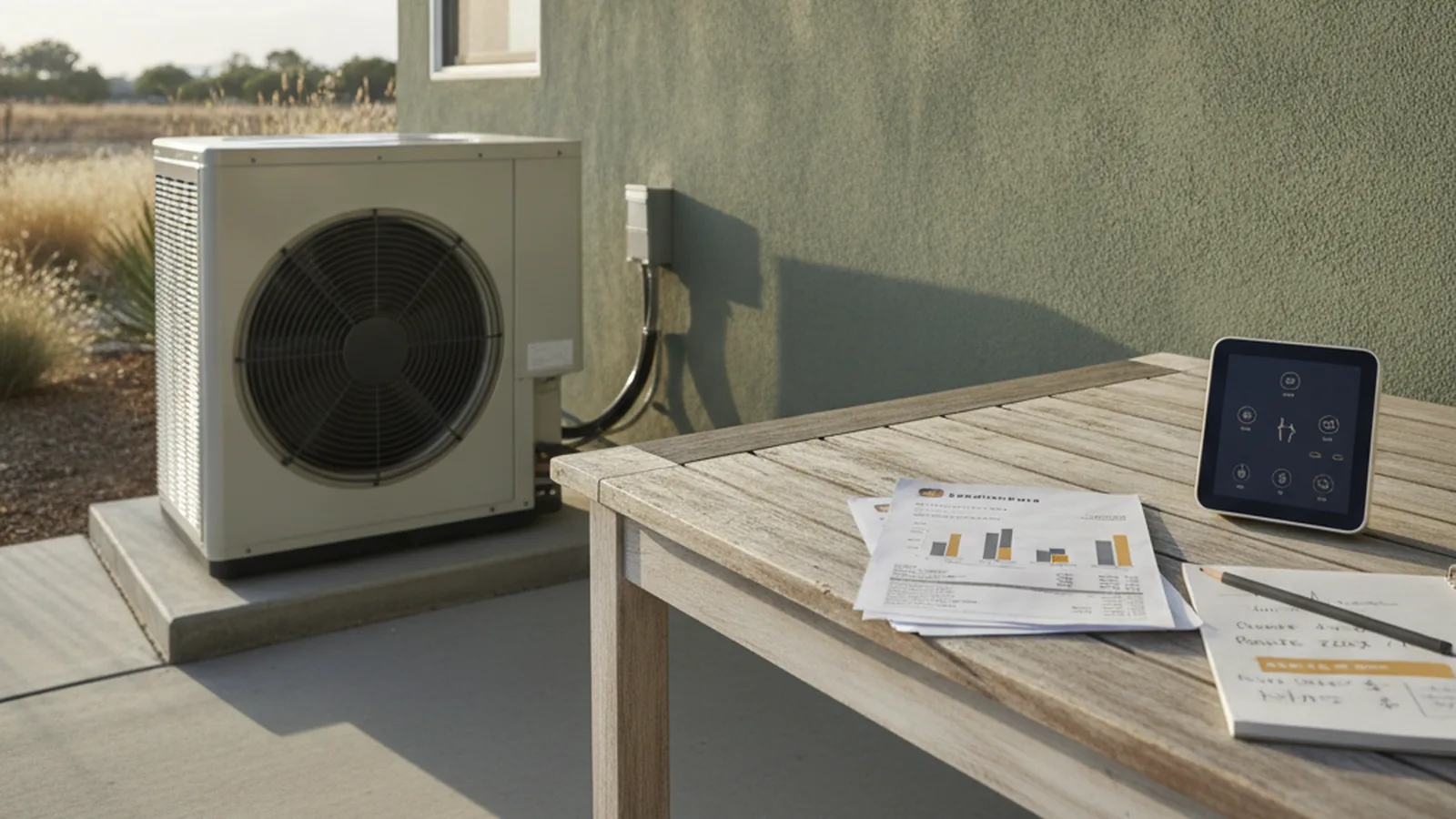
California had the country's largest heat pump incentive programs, and most of that money is now spoken for. A quote written this year can still subtract a TECH or HEEHRA rebate that the contractor cannot actually reserve. This guide shows what a California heat pump costs, which incentives were open as of November 10, 2026, and which ones are not, using the programs' own pages.
We do not sell heat pumps or take a cut of rebates. We help you check a quote before you sign it.
Quick answer
- Typical installed cost: about $19,000 to $20,500 for a whole-home system before incentives. Ductless jobs run lower, around $13,000 to $14,000 in SMUD's data.
- HEEHRA (federal, income-qualified): single-family rebates fully reserved statewide since February 24, 2026, and no new income verification applications. Central and Southern California were fully reserved from January 7, 2026.
- TECH Clean California: its single-family page lists one open campaign, the San Fernando Valley, since November 2, 2026: $2,000 to $10,500 for heat pump HVAC, water heaters and panel upsizing, and $1,300 to $31,800 for income-qualified households.
- LADWP (Los Angeles): $1,000 to $1,250 per ton for ducted systems and $1,500 to $2,500 per ton for ductless, by efficiency tier.
- SMUD (Sacramento): $3,000 for a variable-stage and $2,000 for a two-stage gas-to-electric conversion, $1,000 for an electric-to-electric upgrade, plus up to $5,500 for panels and circuits on a conversion.
- Federal: no 25C tax credit for equipment placed in service after December 31, 2025.
What a heat pump costs in California
SMUD publishes the actual installed prices its customers paid over the past 12 months, refreshed quarterly and limited to single-measure projects, before any rebates. As of November 10, 2026:
| Project | Median installed cost | Lowest | Highest |
|---|
| Gas-to-electric heat pump HVAC, all types | $19,193 | $5,000 | $51,159 |
| Gas-to-electric, split system | $19,455 | $6,441 | $51,159 |
| Gas-to-electric, packaged unit | $19,278 | $7,000 | $50,590 |
| Gas-to-electric, ducted mini-split | $19,000 | $9,100 | $39,111 |
| Gas-to-electric, ductless mini-split | $13,600 | $5,000 | $33,233 |
| Electric upgrade (heat pump replacing electric), all types | $18,455 | $5,000 | $47,209 |
| Electric upgrade, ductless mini-split | $13,229 | $5,000 | $22,309 |
Statewide figures look similar. TECH Clean California's working data set records the total project cost on every incentive application. Across 4,085 market-rate single-family installs completed from January 2025 to May 2026, the median was $20,418, with half between $16,754 and $26,214; a single-zone ductless mini-split ran $11,020. The full breakdown by system type, size, ducts and region is in our real cost of a heat pump analysis.
SMUD lists what pushes a price up: a variable-speed compressor, larger system or home, higher SEER2, new ducts, more mini-split heads, moving the unit, better filtration, zoning, an enlarged return, asbestos abatement, and an attic install instead of a garage.
California heat pump incentives compared
| Program | Who it covers | Amount | Status, checked November 10, 2026 |
|---|
| HEEHRA (federal IRA, via TECH contractors) | Income-qualified single-family owners and landlords | Up to $8,000 below 80% of area median income, up to $4,000 at 80% to 150% | Fully reserved statewide since February 24, 2026; waitlist only |
| TECH Clean California, statewide single-family | California homeowners | Not listed as available | Only the San Fernando Valley campaign is shown as open |
| TECH Clean California, San Fernando Valley | Single-family homeowners in the Aliso Canyon-affected communities | $2,000 to $10,500; $1,300 to $31,800 income-qualified | Open since November 2, 2026, $20 million budget |
| LADWP Consumer Rebate Program | LADWP residential customers | $1,000 to $2,500 per ton | Listed as available, for equipment bought and installed on or after November 1, 2025 |
| SMUD heat pump HVAC rebate | SMUD customers, SMUD Contractor Network installers | $1,000 to $3,000 per system, plus Go Electric panel and circuit rebates up to $5,500 | Listed as available, subject to funding |
| BayREN Home+ heat pump rebate | Bay Area | None | Ended April 2024 |
| Federal 25C tax credit | Everyone | None | Not allowed for property placed in service after December 31, 2025 |
Why most statewide money is gone
TECH Clean California is the statewide program funded under the California Public Utilities Commission, and its trained contractors also deliver the federal HEEHRA rebates. Both have run out of reservations for single-family homes:
- HEEHRA: fully reserved in Central and Southern California from January 7, 2026, and statewide from February 24, 2026. The program stopped accepting new single-family income verification applications, and unapproved requests sit on a waitlist in case money frees up. Multifamily HEEHRA has been fully reserved since September 1, 2026.
- No stacking. Since July 15, 2025, a project cannot receive both a TECH incentive and a HEEHRA rebate, and an approved TECH reservation cannot be switched to HEEHRA.
- San Fernando Valley is the exception. TECH opened $20 million of single-family incentives on November 2, 2026 for communities affected by the Aliso Canyon gas storage facility. Check your address on TECH's San Fernando Valley page. TECH says another $10 million for buildings of two or more units will launch in the winter.
If you are a PG&E, SCE or SDG&E customer outside the San Fernando Valley, assume no statewide heat pump rebate is available unless your contractor can show an approved reservation.
Heat Pump Guide
Want a second read on the quote?
Paste the proposal or upload the PDF. No lead auction.
Free. No sales pitch. Personal reply in ~2 business days.
Still researching? Send me the guide
LADWP: paid per ton, more for ductless
LADWP raised its heat pump rebates for equipment purchased and installed on or after November 1, 2025. The rate depends on system type and efficiency:
| LADWP rebate per ton | Ducted, split or packaged | Ductless mini-split or multi-split |
|---|
| Entry tier (above 15.2 SEER2) | $1,000 | $1,500 |
| Above 16 SEER2 | $1,050 | $1,650 |
| Above 16.9 SEER2 | $1,100 | $1,800 |
| Above 17.8 SEER2 | $1,150 | $1,950 |
| Above 18.7 SEER2 | $1,200 | $2,100 |
| Above 19.6 SEER2 | $1,250 | $2,250 |
| Above 20.5 SEER2 | Not listed | $2,500 |
Each tier also has an HSPF2 minimum. A 3-ton ducted system at the entry tier is worth $3,000; a 3-ton ductless system at the top tier, $7,500. LADWP requires a paid itemized invoice with the matching AHRI certificate and a final approved Building and Safety permit. New construction, ADUs and packaged terminal heat pumps are not eligible. LADWP's page still mentions a federal tax credit of up to $2,000; that credit ended for equipment placed in service after 2025.
SMUD: paid per system
SMUD pays $3,000 for a variable-stage heat pump and $2,000 for a two-stage system (15.2 SEER2 minimum) when it replaces gas heat, and $1,000 when a multi-stage heat pump replaces electric heat. Gas-to-electric conversions can add SMUD's Go Electric rebates for meter panels, subpanels and circuits, up to $5,500. The installer must be in the SMUD Contractor Network and submits the rebate for you; SMUD says the contractor may take the rebate off the price upfront and collect it afterward.
Other local money
Community choice aggregators, air districts and smaller municipal utilities run their own offers that change often. South Coast AQMD's GO ZERO program pays rebates on qualified heat pump installations in its district. The Switch Is On incentive finder, run by TECH's partners, is the most complete ZIP-code lookup we found.
Quote red flags specific to California
- A HEEHRA or TECH incentive is subtracted without an approved reservation in writing, outside the San Fernando Valley campaign.
- The quote combines a TECH incentive and a HEEHRA rebate on the same project.
- An LADWP rebate is assumed for a job with no permit. LADWP requires the final approved Building and Safety permit.
- The LADWP per-ton rate on the quote does not match the system's SEER2 and HSPF2 tier, or a ducted system is priced at ductless rates.
- A SMUD rebate from an installer outside the SMUD Contractor Network.
- A whole-home price far above SMUD's medians with no line items explaining ducts, panel work or zoning.
- A 2026 federal tax credit is subtracted from the price.
Questions to put in writing before signing
- Which rebates does this quote subtract, and do you have an approved reservation or confirmation for each?
- What is the AHRI reference number, and what SEER2 and HSPF2 does the matched system carry?
- Is the price itemized for equipment, ducts or line sets, electrical panel and circuits, permits, and removal of the old system?
- Who pulls the permit, and is it included?
- If a rebate is taken off upfront, what happens if it is denied?
FAQ
How much does a heat pump cost in California in 2026?
About $19,000 to $20,500 installed for a typical whole-home system before incentives. SMUD's data for the past 12 months puts the median gas-to-electric project at $19,193 and the median ductless project at $13,600. Prices ranged from $5,000 to over $51,000.
Are TECH Clean California rebates still available?
Only in the San Fernando Valley campaign that opened November 2, 2026. TECH's single-family page lists no other open single-family offer, and HEEHRA rebates have been fully reserved statewide since February 24, 2026.
How much is the LADWP heat pump rebate?
$1,000 to $1,250 per ton for ducted systems and $1,500 to $2,500 per ton for ductless systems, depending on efficiency, for equipment purchased and installed on or after November 1, 2025.
How much is the SMUD heat pump rebate?
$3,000 for a variable-stage and $2,000 for a two-stage heat pump replacing gas heat, $1,000 for an electric-to-electric upgrade, plus up to $5,500 in Go Electric panel and circuit rebates on a conversion.
Is there a federal tax credit for heat pumps in California in 2026?
No. The IRS says the Energy Efficient Home Improvement Credit is not allowed for property placed in service after December 31, 2025.
What we could not verify
- TECH's remaining budget by region. TECH's budget report is an interactive workbook we could not read as text.
- GO ZERO's current maximum. South Coast AQMD's GO ZERO site shows both a $2,000 and a $3,000 rebate ceiling, so we state no figure.
- Every community choice aggregator and small utility offer. Not checked for this update.
Method and update note
Program status and amounts come from the TECH Clean California incentive, single-family, HEEHRA and news pages, LADWP's Consumer Rebate Program page and SMUD's heating and cooling rebates page, all read November 10, 2026. Cost figures are SMUD's published 12-month medians and our own analysis of the TECH Clean California working data set dated October 20, 2026. The previous version of this page gave no amounts; this rewrite replaces it.
Sources