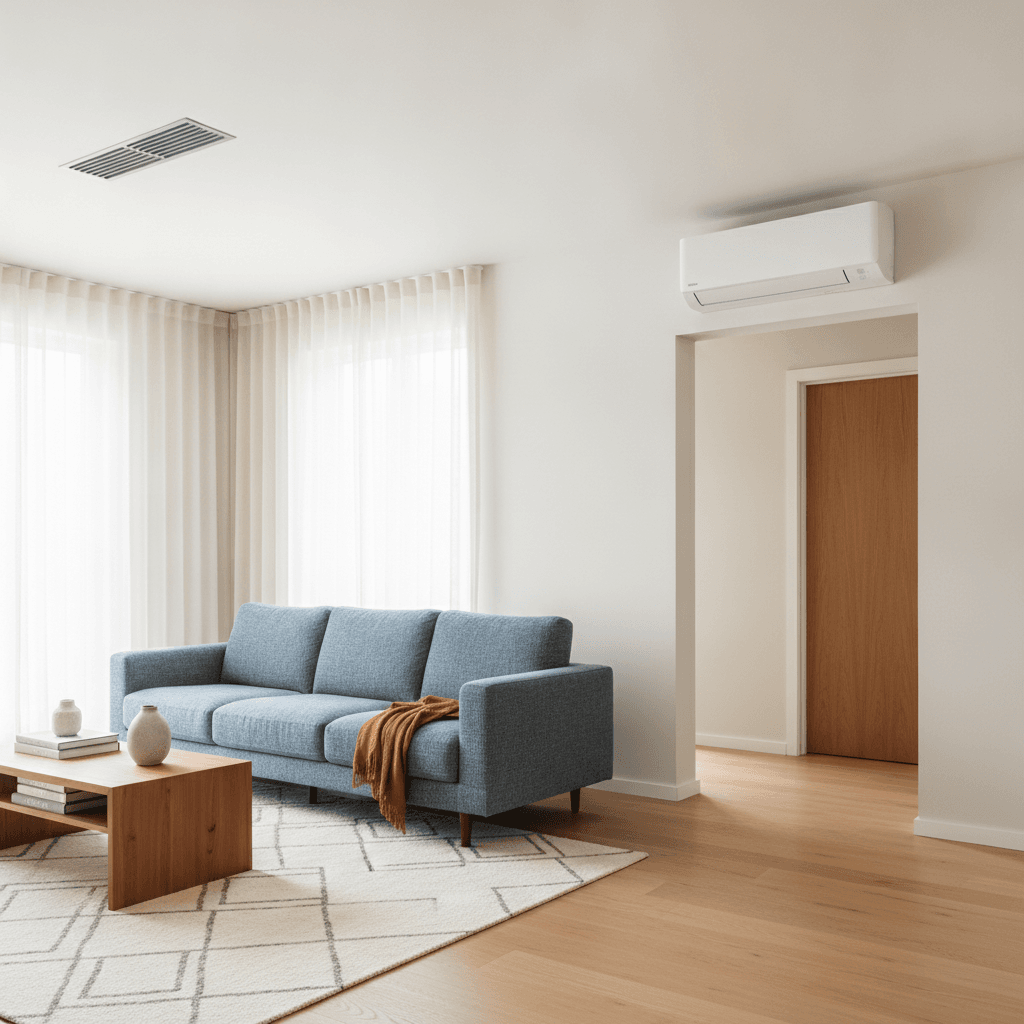
Comparing a ducted quote against a ductless mini-split quote for an older home with uneven rooms and only partial existing ductwork? The two formats are not interchangeable line items on the same bid. They are different distribution plans, and the right one depends on what your ducts can already do, not on which quote arrived first.
Direct answer
Usable ducts that pass a measured static-pressure and leakage check favor a ducted heat pump: one air handler, familiar central-air feel, and no visible indoor hardware. Ducts that are undersized, leaky beyond a simple seal, or that only exist on part of the house favor ductless heads or a mixed system. Either way, the coverage rule that most quotes skip is this: a room that regularly has its door closed, a primary bedroom, a home office, a nursery, needs its own head, a jump duct or transfer grille with a return-air path, or a dedicated ducted branch. A single head in a hallway "covering" three closed-door bedrooms is a design shortcut, not a plan.
Decision table by house condition
| House condition | Recommended format | Why |
|---|
| Usable ducts inside the conditioned envelope, sealed and sized correctly | Ducted | Keeps the central-air feel and avoids new indoor hardware; confirm with a static-pressure test before assuming this |
| Ducts exist but are leaky, undersized, or run through an unconditioned attic or crawlspace | Ductless, or price duct repair as its own line before going ducted | Reusing bad ducts on a heat pump can turn a comfort and efficiency problem into a permanent one |
| Ducts serve only part of the house, such as the main floor of an older two-story | Mixed system: ducted air handler where ducts exist, ductless heads where they do not | Avoids retrofitting ducts into finished space just to keep one format |
| No ducts at all: baseboard, radiators, window units, or an unfinished addition | Ductless | No duct retrofit cost, and each zone gets independent control |
| Uneven or closed-off rooms: primary suite, home office, nursery, guest room behind a door that stays shut | Dedicated head per closed-door room, or a ducted branch with an engineered return | A shared head or trunk line cannot deliver comfort past a closed door with no return path |
The closed-door coverage rule that breaks naive head-count designs
A ductless head conditions the room it sits in and whatever space is openly connected to it. It does not push air through a closed door. The Department of Energy's Building America Solution Center is direct about this: rooms without their own indoor unit "may become uncomfortable," and the fix is either a dedicated head or a small air-transfer fan paired with a return path, "such as a vent between the rooms or undercut doors," so air can circulate back out of the closed room instead of pressurizing it.
That return path matters on the ducted side too. Portland's Clean Energy Community Benefits Fund installation checklist for ducted heat pumps recommends a room-to-room pressurization test, and calls for remediation, a door undercut, a transfer grille, or a dedicated return, whenever a room's pressure exceeds 3 pascals with the door closed. The physics is the same whether the supply comes from a duct register or a wall-mounted head: a closed door without a way for air to get back out turns comfort into a pressure problem, not just a temperature one.
Practical rule: count the doors in the house that are closed more often than not. Each one is either a dedicated head, a duct branch with its own return, or a transfer-air fix, not a line item the contractor can skip.
Static pressure: the ducted test a lot of quotes skip
Before any contractor recommends reusing existing ducts for a heat pump, ask for a measured static-pressure reading, not a visual inspection. ACCA's own guidance on the test is specific: technicians measure total external static pressure (TESP) with a manometer and compare it against the equipment's rated maximum. If the measured value runs 10 to 20 percent or more above that rated maximum, the ducts are restricting airflow enough to hurt performance. Portland's ducted heat pump checklist goes further and calls for flow-plate testing of airflow across the coil, following ANSI/ACCA Standard 5 QI-2015 procedures, to confirm delivered CFM sits within the range the equipment manufacturer specifies. Neither test is expensive or slow. A quote that recommends "ducted, ducts are fine" without one of these numbers attached is guessing.
Heat Pump Guide
Want a second read on the quote?
Paste the proposal or upload the PDF. No lead auction.
Free. No sales pitch. Personal reply in ~2 business days.
Still researching? Send me the guide
2026 installed cost delta by configuration
These are this site's own 2026 quote-screening bands, the same ones used in the buying guide and the quote calculator, not an independent market average.
| Configuration | 2026 installed range | What moves the number |
|---|
| Single-zone ductless | $4,000-$8,000 | One head, one outdoor unit, minimal electrical |
| Multi-zone ductless, 3-5 heads | $9,000-$18,000 | Each additional head adds roughly $2,500-$4,500 |
| Ducted whole-home, ducts usable as-is | $12,000-$18,000 | Confirmed by a static-pressure and leakage check, not assumed |
| Ducted whole-home, duct repair or panel/service electrical work added | $18,000-$25,000 and up | Duct sealing, resizing, or a panel upgrade, priced separately, see the ductwork cost guide and the panel upgrade guide |
| Mixed system: ducted first floor plus 1-2 ductless heads elsewhere | Roughly the ducted whole-home range plus $2,500-$4,500 per added head | Common in older two-story homes with ducts on one level only |
This site does not yet have an independent, itemized price table for duct sealing or repair by scope, so budget that as its own conversation with the contractor rather than assuming it is folded into the ducted number above.
Mixed systems: often the honest answer for older two-story homes
A lot of pre-1960s houses were built with ducts serving the main floor from a basement furnace, and nothing serving an added second floor, a finished attic, or a sunroom. Retrofitting ducts into that finished space to force a single-format decision is expensive and sometimes not possible without opening walls or ceilings. A mixed system, a ducted air handler on the floor that already has ducts, and one or two ductless heads on the floor that does not, usually costs less than a full duct retrofit and solves the coverage problem directly instead of working around it.
The tradeoff is two systems to service and two control schemes for the homeowner to learn, though most current cold-climate lineups support a shared outdoor condenser with a mix of a ducted air handler and ductless heads on one refrigerant circuit. Ask the installer to confirm the specific outdoor unit supports a mixed indoor lineup before assuming any brand allows it.
Comfort and aesthetics tradeoffs
- Ducted hides all indoor hardware, mixes air more evenly across a room through supply and return grilles, and needs only one filter to service. The tradeoff: everything on that duct run shares one setpoint unless the system has zoning dampers, and a bad duct design is expensive to fix after drywall goes back up.
- Ductless gives each room independent temperature control and skips duct retrofit cost entirely. The tradeoff: a visible wall or ceiling cassette in every conditioned room, a filter to clean per head, and exposed line sets outside unless the installer runs them through a wall cavity or line-hide cover.
- Mixed keeps ducted comfort where ducts already work and adds ductless control where they do not, at the cost of two systems to explain to the next owner if the house sells.
Quote red flags for distribution choice
- The proposal recommends reusing existing ducts with no static-pressure or leakage number attached.
- A single ductless head is priced to "cover" two or more rooms that are normally kept behind closed doors, with no transfer fan, jump duct, or dedicated head named.
- The quote treats duct repair as a vague allowance instead of naming what was tested and what will be sealed, resized, or replaced.
- A mixed-system quote does not confirm the specific outdoor unit model supports both a ducted air handler and ductless heads together.
- Room-by-room head or duct-branch assignment is missing; the proposal just states a total BTU number for the house.
What to ask before signing
- What was the measured static pressure or leakage result on the ducts we plan to reuse?
- Which rooms in this design will have their door closed most of the time, and what is the coverage plan for each one?
- If this is a mixed system, does the exact outdoor model support a ducted air handler and ductless heads on the same circuit?
- What is the added cost for duct repair, an extra head, or a transfer-air fix, itemized separately from the base quote?
- If we go ductless, where will the line sets and disconnects be visible from outside and inside?
FAQ
Can I mix ducted and ductless heat pumps in one house?
Yes, and it is a common, sensible answer for older two-story homes where ducts exist on one level and not the other. Confirm the outdoor unit model is rated to run both a ducted air handler and ductless heads together before signing.
Will one ductless head really not reach a bedroom with the door closed?
Not reliably. A head conditions the space it is in and whatever is openly connected to it. A closed door with no return path stops that airflow, which is why the Department of Energy's guidance on ductless design calls for a dedicated head or a transfer fan paired with a vent or undercut door for any room that stays closed off.
My ducts only cover the downstairs. Should I still go all-ductless?
Not necessarily. If the downstairs ducts pass a static-pressure and leakage check, keeping a ducted air handler there and adding ductless heads upstairs is usually cheaper than ripping out working ducts to standardize on one format.
Is a static-pressure test worth the extra step before choosing ducted?
Yes. It is a low-cost test, and it is the difference between a contractor who verified the ducts can support the new equipment and one who assumed it.
Is the cheapest quote between a ducted and ductless bid usually the right one?
No. Compare them only after each includes the same coverage plan for closed-door rooms, the same electrical scope, and, on the ducted side, a static-pressure result rather than an assumption.
Where to go next
- Work the full seven-step decision path, including sizing and electrical scope, in the heat pump buying guide.
- See the full installed-cost breakdown, including backup heat and rebates, in the real cost of a heat pump.
- If ducts are part of the plan, read the ductwork cost guide before signing anything that reuses them.
- Cold-climate markets should shortlist equipment in the cold-climate heat pump guide, then send the written quote for a free quote review.
If this is a cooling-first replacement decision rather than a heating conversion, compare the same distribution tradeoff in our sister site's central AC versus ductless mini-split guide. It starts from the existing-AC buyer's question, while this page stays focused on heat-pump scope and closed-door coverage.
What we could not verify
- An independent, multi-contractor cost dataset for the price of adding a single ductless head to an existing multi-zone system. The $2,500-$4,500 figure above is this site's own published band, not a third-party average.
- A universal numeric rule for exactly how many closed-door rooms tip a house from ducted to ductless. That remains a design judgment made room by room, not a formula.
- An itemized, dollar-priced table for duct sealing or repair scope specifically. The ductwork cost guide covers what to test and ask for, but not yet a priced range.
Sources